This website stores cookies on your computer. These cookies are used to collect information about how you interact with our website and allow us to remember you.
We use this information in order to improve and customize your browsing experience and for analytics and metrics about our visitors both on this website and other media.
To find out more about the cookies we use, see our Privacy Policy.
Dedicated CLE Manager
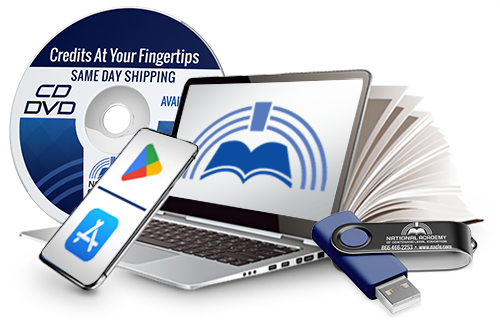
Online, iOS/Android, CD/DVD/USB
Free Customized CLE Tracker
Accreditation and CLE Rules for Florida
The National Academy of Continuing Legal Education is a Florida Bar Accredited CLE Sponsor (Sponsor # 0185716).
Florida attorneys must complete a minimum of 30 CLE credit hours every 3 years. Five of the 30 credit hours must be in approved "professional responsibility" programs which includes ethics, professionalism, substance abuse, and mental illness awareness programs, and 3 hours must be in approved technology programs. Attorneys must now also take a new 2 credit Professionalism course provided directly by the Florida Bar at no extra charge. We make this free professionalism course easily accessible within your account with us.
Florida attorneys can complete all 30 CLE Credit hours including 5 hours of professional responsibility and 3 hours of technology with our DVDs, Audio CDs, USB Stick, Online, and iOS/Android App courses. Currently, the Florida Bar only offers online access to the 2 hour mandated professionalism course which we make accessible within your online account. Preapproved courses offered by the National Academy of Continuing Legal Education have been directly approved by The Florida Bar and come with unique Florida Bar course codes which enables easy and quick reporting. “Self-Report” courses come with prefilled forms for easy self-reporting to the FL Bar.
Each Florida attorney and FRP is assigned a 3 year compliance period that ends on the last day of their designated month. You can find your compliance date by logging into your Florida Bar Profile.
Florida Registered Paralegals (FRP’s) must complete a minimum of 30 hours of CLE every three years to maintain their status. Of the 30 hours, 5 hours must be in ethics or professionalism and three 3 hours must be in technology. FRP's can satisfy all 30 mandated continuing education hours with our preapproved DVDs, Audio CDs, USB Stick, Online, and iOS/Android App courses since they are directly approved by The Florida Bar.
The Florida Bar
651 E. Jefferson St.
Tallahassee, FL 32399-2300
(t) 850-561-5842
(f) 850-561-9421
Web: Florida Bar CLE Page
Structured Settlements and Pooled Trusts: Protecting Clients who are Vulnerable or Disabled
CLE Courses Available on DVDs, Audio CDs, USB Stick, Online & iOS/Android App!
General Credits
1
Self-Report
$50
LIVE WEBINAR
June 19
Friday, June 19, 2026
11:00AM - 12:00PM Eastern Time (EDT)
About This Course
This CLE presentation provides practical strategies to help attorneys protect clients who are vulnerable or disabled and who are receiving a settlement or judgment. It focuses on when to use a pooled special needs trust for clients with disabilities, how to use settlement preservation pooled trusts for clients such as minors who are vulnerable but may not be disabled, and how structured settlements can be integrated into a comprehensive planning strategy.
Presenters will outline how to determine whether a pooled special needs trust or a settlement preservation pooled trust is appropriate for a particular client and how to evaluate available trust options. A first-party pooled special needs trust allows settlement funds to be excluded as countable resources, helping clients maintain eligibility for programs such as Medicaid and Supplemental Security Income (SSI).
The session will also highlight the role of pooled settlement preservation trusts—not only for individuals with disabilities, but also for minors and other vulnerable clients, including individuals who are incarcerated. Pooled settlement preservation trusts provide oversight and structure to help ensure funds are managed responsibly, reducing risk for both clients and counsel.
Attendees will receive a practical overview of key public benefits programs, an explanation of special needs trusts, and a comparison of pooled versus standalone trust options. The presentation will also cover key considerations in determining suitability, including disability status, settlement size, age (including clients age 65 and older), and current or anticipated eligibility for means-tested benefits, along with guidance on evaluating pooled trust administrators.